Colophon
Scriptorium — a reading list, a bibliography, and the notes that come of them.
The initial
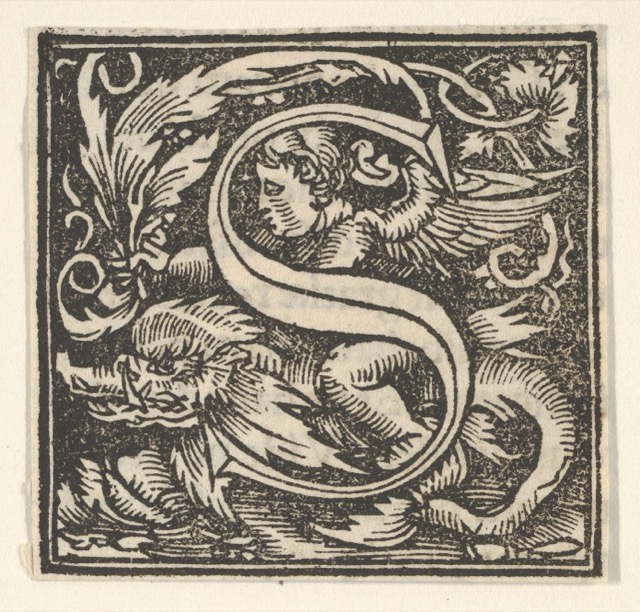
The initial is a woodcut by Heinrich Vogtherr the Elder (German, born 1490, active 1538–1540), one of an alphabet of ornamental capitals he cut around 1538. Each letter is a block about an inch and a half square — 4.7 by 4.7 centimetres — with a putto climbing through the letterform. Vogtherr worked in Strasbourg and Augsburg as a painter, block-cutter and printer, and published pattern books of ornament for other craftsmen to copy; an initial like this one was a working tool, sold to be set at the head of a chapter.
The sheet is in the collection of the Metropolitan Museum of Art, New York, acquired by purchase through the Anne and Carl Stern Gift in 1959, and released under the Museum’s Open Access programme. This copy came by way of Wikimedia Commons.

It is here because a printer’s initial is the thing this application is named for. A scriptorium is where a text is copied by hand, and the initial is where the copying shows itself as labour rather than as transmission. Everything below it — the printed folio on every quotation, the passage kept verbatim, the citation built to survive a defence — rests on the same claim: that the page a sentence sat on is part of what the sentence is.
The faces
Reading copy is set in Literata, drawn by TypeTogether as a screen face for long-form reading; it has true italics, which the Spanish titles need. The instrument around the reading — navigation, labels, filters — is Geist. Page text from a book is justified with hyphenation in the language of that book, and paragraphs are marked by an indent rather than by a space, which is how the books themselves are set.
The rest
Next.js on Vercel; Postgres with pgvector on Neon; embeddings from Voyage. Page text is extracted from PDFs with PyMuPDF and kept verbatim, down to the printed folio, because a quotation that cannot be checked against the page it came from is not evidence.